Home > Social Reform in the Athens’ Black Community > Judia Jackson Harris
Judia Jackson Harris: Educator, Community-Builder, and Activist
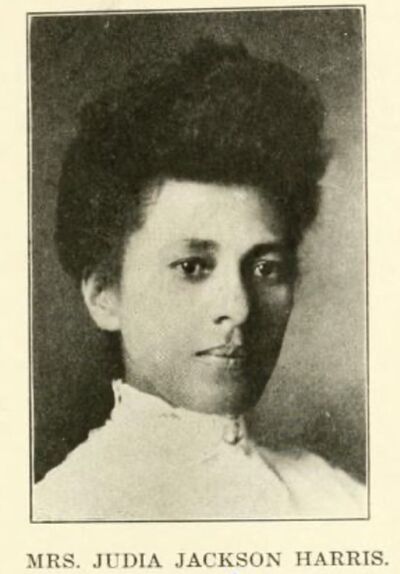
Judia Jackson Harris in portrait printed in Caldwell’s 1917, History of the American Negro and his Institutions (p. 643). The book is available at HathiTrust.
Judia Jackson Harris (1870-1960) was a Black educator and social reformer who pioneered a model of teacher training, schooling, and cooperative land ownership in rural Clarke County. Though remembered primarily as an educator, she pursued a broad program of reform that paired land ownership with literacy to advance the interests of Black Georgians during the Jim Crow era.
Judia Jackson Harris was born in Athens to Alfred and Louisa Jackson in early 1870. She was the last of eight children and one of only two to be born after Emancipation. Though Alfred and Louisa could not read or write, all of their children were literate, and three of their daughters—Camilla, Mary, and Judia—became educators and activists. Jackson Harris received her basic schooling in Athens and then followed her older sister, Mary Jackson McCrorey (1867-1944), to Atlanta University, graduating from its “normal” (or teaching) course in 1894.
In August 1900 Jackson Harris began organizing Black farmers near Helicon Springs, a rural community north of Athens (Thurmond, 2019). She believed the community could become a “model rural settlement,” and together, the farmers and Jackson Harris established the Mutual Benefit Association (also known as The Corn Club) for the purpose of “buying land, building and improving homes, and establishing a model school” (Jackson, 1903). Despite the threat of violent resistance from local whites, the Association—then with ten dues-paying members, including Jackson Harris herself—put a deposit on their first forty-one acres of land in December 1900 (Jackson Harris, 1954). Over the next few decades, the Association purchased a sawmill, a cotton gin and an additional 2,000 acres of land, becoming a full “social settlement” with industrial classes and lectures among its many offerings. After twenty years, Black families owned nearly all the land in the community, which had the highest percentage of Black property owners of any section in Clarke County.
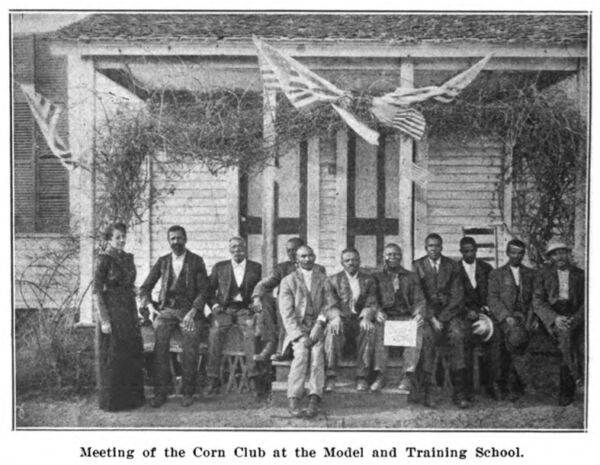
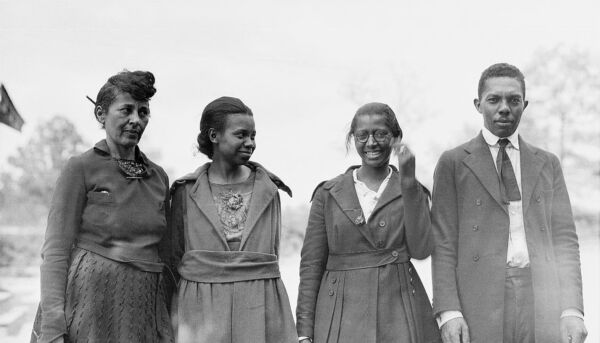
Judia Jackson Harris with members of the Corn Club, a collective of Black farmers in 1915.

Judia Jackson Harris remained as principal of her school from its founding in 1903 until her retirement in 1949, though the school’s name changed from the Model & Training School to the Clarke County Training School, and eventually to the Judia C. Jackson Harris School. In this 1921 photo by Jackson Davis, we see one of Jackson Harris’s teachers with some of the school’s many pupils.
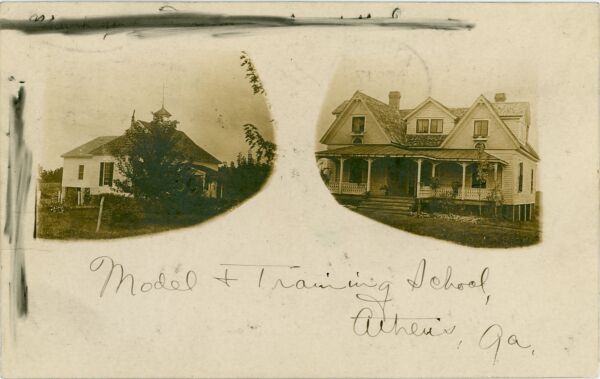
Jackson Harris opened the Model and Training School in 1903 on her share of the Mutual Benefit Association land, which she deeded to the Clarke County School Board (Jackson Harris, 1954). To open the school, she had support from the General Education Board, the Peabody Fund, and later, from the Slater Fund, the Julius Rosenwald Fund, Clarke County Schools, and many of Athens’ white community leaders, including David C. Barrow, Jr., who served as Chancellor of the University of Georgia from 1906 to 1925.
National leaders in the Black community, including W. E. B. Du Bois and George Washington Carver also expressed their support.
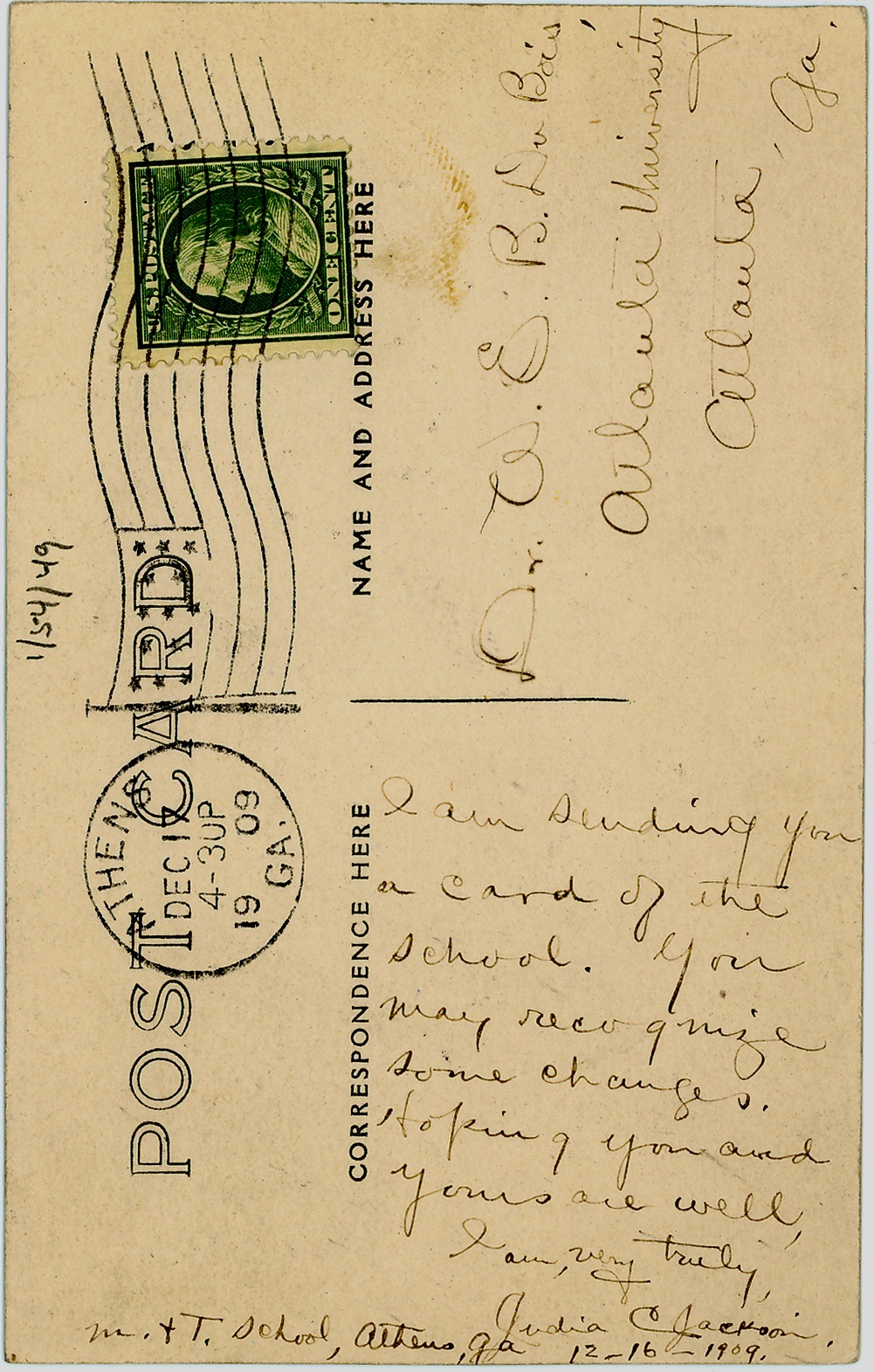
In 1909, the unmarried Judia Jackson sent this postcard of the Model & Training School to W. E. B. Du Bois. The text of the card, which states, “you may recognize some changes,” suggests that Du Bois had previously visited the property.
The first of its kind in the South, the school combined a model curriculum with a teacher training institute (Athens Banner, 1911). Music, theater, literature, blacksmithing, sewing, and manual training were all features of the curriculum. When school was not in session during the summer, teacher training was held for the county’s Black teachers. Additionally, the school—together with the Mutual Benefit Association—attracted crowds with their annual agricultural fairs during which canned goods, livestock, and quilts were exhibited and prizes won. Students presented yearly musical pageants, often at the Morton Theater in downtown Athens.
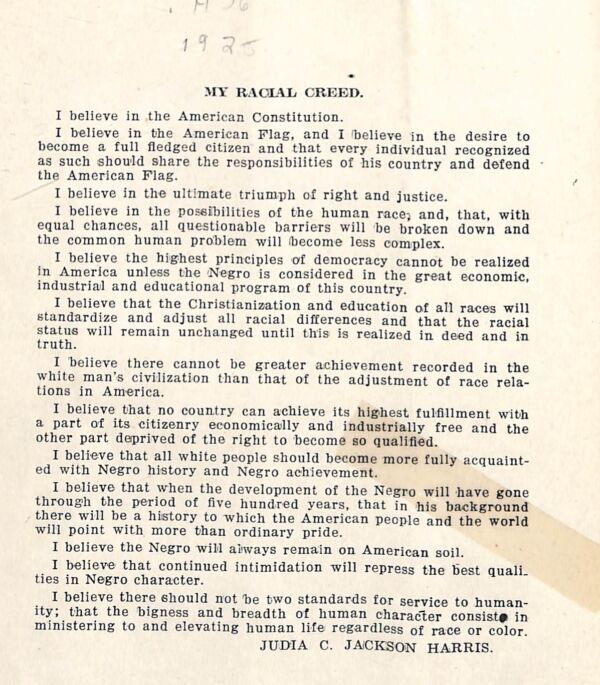
Judia Jackson Harris (1870-1960), a Black educator and social reformer, published her “racial creed” alongside testimonials from prominent white Athenians in Race Relations (1925).
Hargrett Library, UGA
In response to the 1921 lynching of John Lee Eberhart in Athens, Jackson Harris wrote and published a small book entitled, Race Relations, which included her “racial creed” alongside letters of support from white local, state, and southern leaders (Jackson Harris, 1954). In her creed, she pushed back against Jim Crow, writing “I believe that no country can achieve its highest fulfillment with a part of its citizenry economically and industrially free and the other part deprived of the right to become so qualified.” She challenged white citizens to learn more: “I believe that all white people should become more fully acquainted with Negro history and Negro achievement.” In response to the 1921 lynching of John Lee Eberhart in Athens, Jackson Harris wrote and published a small book entitled, Race Relations, which included her “racial creed” alongside letters of support from white local, state, and southern leaders. In her creed, she pushed back against Jim Crow, writing “I believe that no country can achieve its highest fulfillment with a part of its citizenry economically and industrially free and the other part deprived of the right to become so qualified.” She challenged white citizens to learn more: “I believe that all white people should become more fully acquainted with Negro history and Negro achievement” (Jackson Harris, 1925).
For over nearly 50 years—and through challenges that included the Ku Klux Klan and racist violence, fire, and the boll weevil—Jackson Harris continued her leadership in the school and her work in the community (Jackson Harris, 1954; MacLean, 1995). She retired from the newly renamed Judia Jackson Harris School in 1949, and when asked to evaluate the impact of her life’s work, she credited the collective, writing that “the major part of what has been accomplished has been done by group action” (Jackson Harris, 1954).

Students and teachers assemble in front of the Rosenwald-funded brick school building, which replaced the original school after a fire in 1925.
James Reap collection, Hargrett Library. University of Georgia

The Judia C. Jackson Harris School still stands.
Photograph (2021) courtesy of Jane McPherson
Jackson Harris died in 1960. In 2009 Athens-Clarke County Schools opened the J. J. Harris Elementary School in her honor. Though the Rosenwald-era Judia Jackson Harris School building still stands, it was placed on Historic Athens’ “places in peril” in 2020.
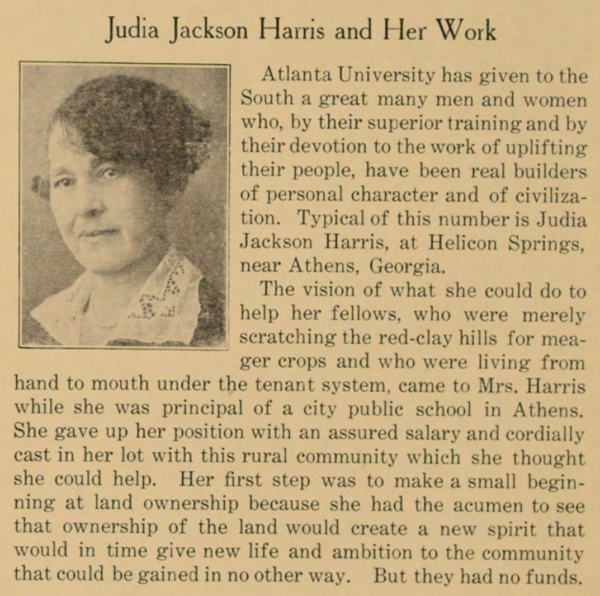
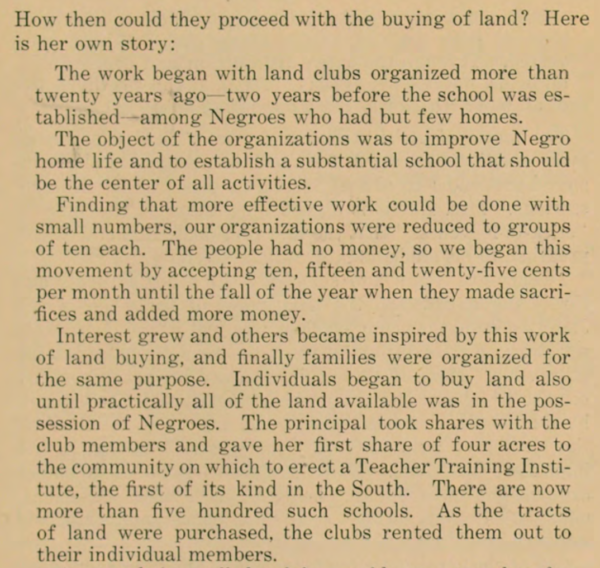
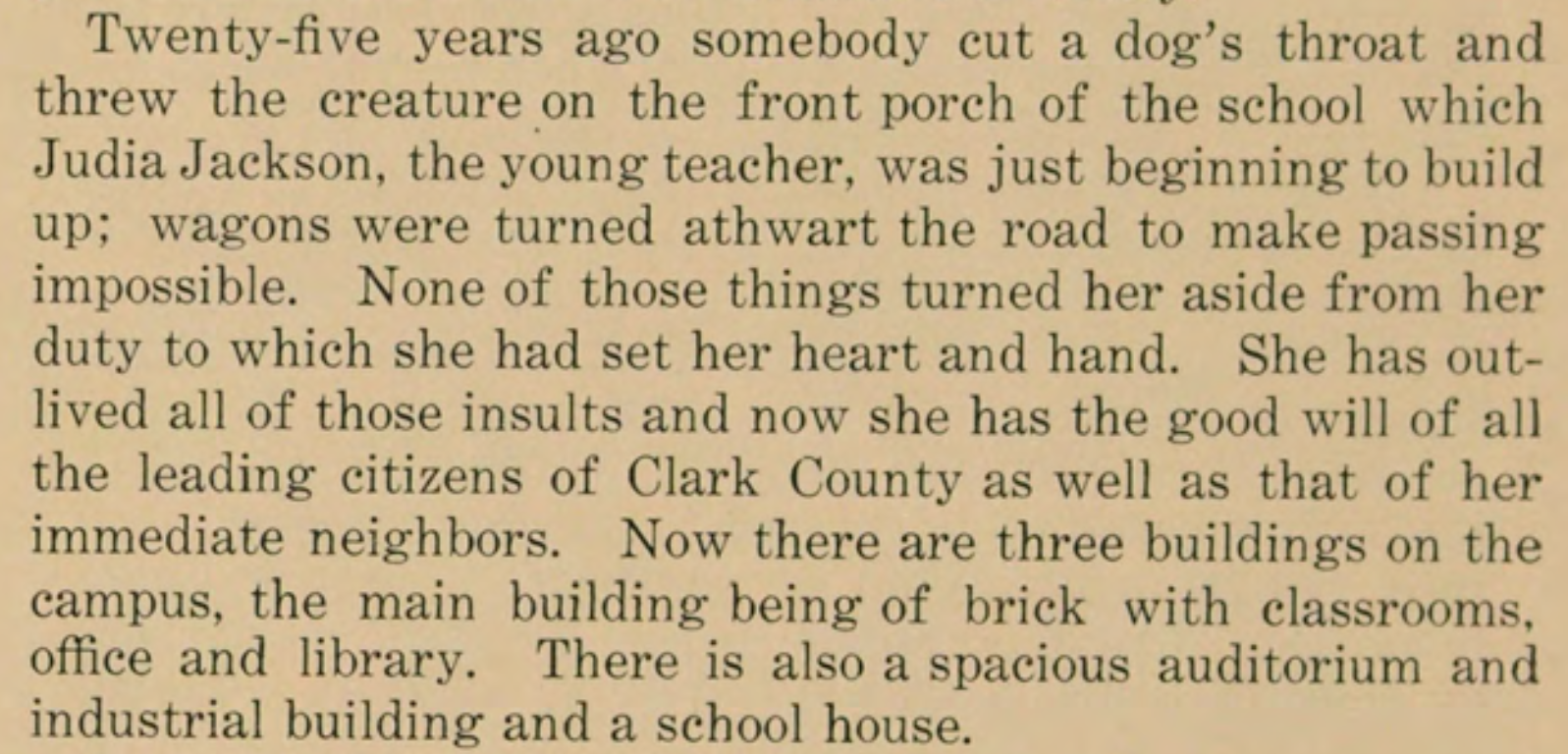
In 1928, George A. Towns celebrated the work of Judia Jackson Harris in the Atlanta University Bulletin.


Cite this Article
McPherson, J. (2026, July 21). Judia Jackson Harris. In New Georgia Encyclopedia. Retrieved April 24, 2025, from https://www.georgiaencyclopedia.org/articles/history-archaeology/judia-jackson-harris/
The text on this page was condensed from Jane McPherson’s 2025 longer article in the New Georgia Encyclopedia. Please see the New Georgia Encyclopedia for more.
For More Information
McPherson, J. (2025). A Call to Remember: Three Generations of Jackson and Brydie Educators on North Finley Street. Athens Historian, 24-25, 1-20.
McPherson, J. (2026). Judia Jackson Harris: Educator and Social Welfare Pioneer. Social Welfare History Project.https://socialwelfare.library.vcu.edu/people/jackson-harris-judia/
Sources
Athens Banner (1911), “The only training school for negroes in rural section,” 14 September, https://gahistoricnewspapers.galileo.usg.edu/lccn/sn88054098/1911-09-14/ed-1/seq-7/print/image_552x817_from_0,0_to_3775,5582/
Jackson, Judia C. “The Upbuilding of a Community” Southern Workman, 32(5), 1 May 1903, 200-203. https://virginiachronicle.com/?a=d&d=SWM19030501.1.10
Jackson Harris, Judia. (1925). Race Relations. Athens, GA. In the collection of the Hargrett Library, University of Georgia.
Jackson Harris, Judia. (1954). Forty Years of Experience in a Georgia Community. (Unpublished memoir, 1954). Cited with permission of the Jackson family.)
MacLean, Nancy. (1995). Behind the Mask of Chivalry: The Making of the Second Ku Klux Klan (New York: Oxford University Press, 1995)
Thurmond, M. L. (2019). A story untold: Black men and women in Athens history (3rd ed.). Deeds Publishing.
